Transition Metal Dichalcogenides (TMDs or TMDCs)

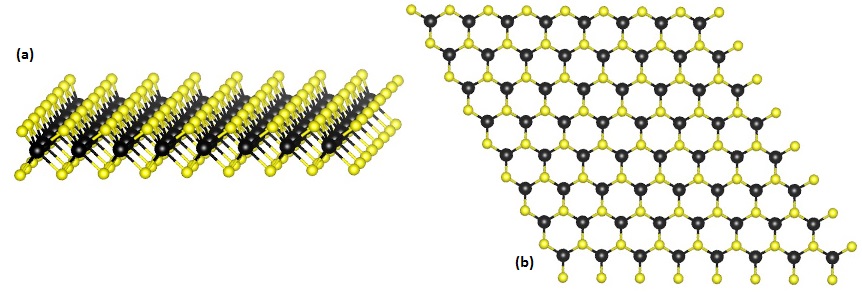
Electrons and holes in monolayer TMDs have an enhanced coulomb interaction due to the atomically-thin nature of the system. Because of this, excitons persist even at room-temperature and dominate the PL spectrum with their recombination emission.
TMDs are intriguing materials due to a few reasons:
- Direct bandgap
- Multiple valleys (minimum in conduction band) that electrons can excite to
- Strong spin-orbit coupling
- Broken-inversion symmetry (turn it around 180˚ and it looks different)
The strong spin-orbit coupling results in the electronic bands splitting, and this fact combined with the broken inversion symmetry leads to an effect known as spin-valley locking.
One can confirm the existence of a monolayer of TMDs by collecting photoluminescence produced by electron/hole recombination with a spectrometer, because TMDs consisting of >1 layers will have an indirect band-gap and the electron/hole recombination processes will not be predominantly optical.
